Photo of a Diwali Puja taken during a Hindu prayer ceremony on the eve of Diwali by Deepak Gupta

The following is an excerpt from chapter four of the book Think on These Things by Jiddu Krishanmurti who, at the time, was speaking to a group of school children in India. They asked some tough, penetrating questions, and Krishnamurti gave them some simple yet profound and enlightened answers.
~~~~~~~~~~~~~~~~~~~~~~~~~~~~~~~~~~~~~~~~~~~~~~~~~~~~~~~~~~~
Questioner: Is not the worship of God true religion?
Krishnamurti: First of all, let us find out what is not religion. Isn't that the right approach? If we can understand what is not religion, then perhaps we shall begin to perceive something else. It is like cleaning a dirty window - one begins to see through it very clearly. So let us see if we can understand and sweep out of our minds that which is not religion; don't let us say, "I will think about it" and just play around with words. Perhaps you can do it, but most of the older people are already caught; they are comfortably established in that which is not religion and they do not want to be disturbed.
So, what is not religion? Have you ever thought about it? You have been told over and over again what religion is supposed to be - belief in God and a dozen other things - but nobody has asked you to find out what is not religion; and now you and I are going to find out for ourselves.
In listening to me, or to anyone else, do not merely accept what is said, but listen to discern the truth of the matter. If once you perceive for yourself what is not religion, then throughout your life no priest or book can deceive you, no sense of fear will create an illusion which you may believe and follow. To find out what is not religion you have to begin on the everyday level, and then you can climb. To go far you must begin near, and the nearest step is the most important one. So what is not religion? Are ceremonies religion? Doing puja over and over again - is that religion?
True education is to learn how to think, not what to think. If you know how to think, if you really have that capacity, then you are a free human being - free of dogmas, superstitions ceremonies - and therefore you can find out what religion is.
Ceremonies are obviously not religion, because in performing ceremonies you are merely repeating a formula which has been handed down to you. You may find a certain pleasure in performing ceremonies, just as others do in smoking or drinking; but is that religion? In performing ceremonies you are doing something about which you know nothing. Your father and your grandfather do it, therefore you do it, and if you don't they will scold you. That is not religion, is it?
And what is in a temple? A graven image fashioned by a human being according to his own imagination. The image may be a symbol, but it is still only an image, it is not the real thing. A symbol, a word, is not the thing it represents. The word 'door' is not the door, is it? The word is not the thing. We go to the temple to worship - what? An image which is supposed to be a symbol; but the symbol is not the real thing. So why go to it?
These are facts; I am not condemning; and, since they are facts, why bother about who goes to the temple, whether it be the touchable or the untouchable, the brahman or the non-brahman? Who cares? You see, the older people have made the symbol into a religion for which they are willing to quarrel, fight, slaughter; but God is not there. God is never in a symbol. So the worship of a symbol or of an image is not religion.
And is belief religion? This is more complex. We began near, and now we are going a little bit farther.
Is belief religion? The Christians believe in one way, the Hindus in another, the Moslems in another, the Buddhists in still another, and they all consider themselves very religious people; they all have their temples, gods, symbols, beliefs. And is that religion? Is it religion when you believe in God, in Rama, Sita, Ishwara, and all that kind of thing? How do you get such a belief? You believe because your father and your grandfather believe; or having read what some teacher like Shankara or Buddha is supposed to have said, you believe it and say it is true. Most of you just believe what the Gita says, therefore you don't examine it clearly and simply as you would any other book; you don't try to find out what is true.
We have seen that ceremonies are not religion that going to a temple is not religion, and that belief is not religion. Belief divides people. The Christians have beliefs and so are divided both from those of other beliefs and among themselves; the Hindus are everlastingly full of enmity because they believe themselves to be brahmans or non-brahmans, this or that. So belief brings enmity, division, destruction, and that is obviously not religion.
Then what is religion? If you have wiped the window clean - which means that you have actually stopped performing ceremonies, given up all beliefs, ceased to follow any leader or guru - then your mind, like the window, is clean, polished, and you can see out of it very clearly. When the mind is swept clean of image of ritual, of belief, of symbol, of all words, mantrams and repetitions, and of all fear, then what you see will be the real, the timeless, the everlasting, which may be called God; but this requires enormous insight, understanding, patience, and it is only for those who really inquire into what is religion and pursue it day after day to the end. Only such people will know what is true religion. The rest are merely mouthing words, and all their ornaments and bodily decorations, their pujas and ringing of bells - all that is just superstition without any significance. It is only when the mind is in revolt against all so-called religion that it finds the real.
~~~~~~~~~~~~~~~~~~~~~~~~~~~~~~~~~~~~~~~~~~~~~~~~~~~~~~~~~~~
About the Author
J. Krishnamurti (1895-1986) was a renowned spiritual teacher whose lectures and writings have inspired thousands. His works include On Mind and Thought, On Nature and the Environment, On Relationship, On Living and Dying, On Love and Lonliness, On Fear, and On Freedom.
(Think On These Things is an excellent first-read for people interested in Krishnamurti's inspirational insights. I own and have read many of his thought-provoking books. ~Michelle~)
Average Customer Review: 
based on 31 reviews.

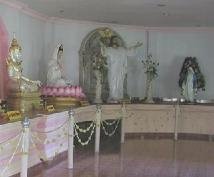
 From a temple display in Thailand: L. to R.: White Tara, Buddhist Bodhisattva of Compassion; Guan Shi Yin, Daoist Bodhisattva of Compassion; Jesus Christ; Virgin Mary